In the summer of 1967, a young man from Cambridge stood at the center of the universe — at least as far as psychedelic rock was concerned. Roger Keith "Syd" Barrett, founder of Pink Floyd, was the genre's most luminous figure: a songwriter of astonishing originality, a guitarist whose playing was unlike anyone else's, a poet who made nonsense feel profound and profundity feel playful. He was 21 years old, and the world was just beginning to catch up with the strange, shimmering frequency of his mind.
Less than two years later, he was gone — not dead, but absent in ways that proved harder to explain than death. He would live until 2006, retreating to his mother's house in Cambridge, painting, gardening, and declining all contact with the band that had made him famous. Pink Floyd, without him, would go on to sell hundreds of millions of records. Syd would go on to become one of rock's most haunting figures — a cautionary tale, a romantic myth, and, for those who look more closely, a deeply human story about what happens when the channel between the head and the heart is overwhelmed rather than opened.
A Mind That Moved Too Fast
Syd Barrett grew up in a comfortable, culturally rich Cambridge household. His father, a pathologist with a love of music, died when Syd was 14 — a loss that left a mark the boy carried quietly for the rest of his life. He was charming and artistic, well-liked, funny. At the Cambridge College of Arts and Technology and later at Camberwell College of Arts in London, he developed the visual sensibility that would inform his surrealist lyrics — paintings in sound, images that glittered at the edge of meaning.
When Pink Floyd formed in the mid-1960s, Syd was the engine of everything. He wrote the songs, developed the band's improvisational stage show, and gave their music its distinctive sense of childlike wonder edged with darkness. Tracks like See Emily Play, Arnold Layne, and Astronomy Domine were unlike anything else on the radio. The debut album, The Piper at the Gates of Dawn, recorded at Abbey Road in the same building where The Beatles were laying down Sgt. Pepper's, remains one of the most original works in British rock. It is entirely a product of Syd's imagination.
He had something genuinely singular — not just talent, but a way of perceiving the world that translated into music no one else could have made. The tragedy is not that he burned out. The tragedy is how alone he must have felt while it was happening.
The Channel Flooded: When the Head Takes Over
The story of Syd Barrett is often told as a story about LSD, and that is not wrong. He took enormous quantities of acid during the band's ascent, often in uncontrolled settings, often alone. But to reduce what happened to him to drug use alone is to miss the deeper current running beneath the surface. Many musicians of his era took as much or more and did not vanish. What Syd experienced was a catastrophic disconnection — a flooding of the channel between intellect and emotion that left him stranded in a place no map could locate.
In the language of recovery and spiritual growth, there is a concept called getting "out of the head and into the heart." The head is where fear lives, where obsessive thought loops run endlessly, where the ego constructs elaborate defenses and the mind mistakes its own noise for reality. The heart is where genuine feeling, connection, and creative life are rooted. A healthy creative life requires a clear channel between the two — the mind's pattern-recognition serving the heart's deeper knowing.
"For Syd, that channel was extraordinary — and then it was overwhelmed. The psychedelic experiences that unlocked his imagination ultimately flooded the circuits that regulated it. The head could no longer organize what it was receiving. The heart could no longer be heard through the static.
By 1968, bandmates Roger Waters, David Gilmour, Richard Wright, and Nick Mason were watching Syd deteriorate in real time. He would stand motionless on stage, staring into the middle distance, guitar detuning as he strummed the same note for twenty minutes. He would arrive to recording sessions and contribute nothing — or arrive with songs that could not be salvaged, their structure dissolved into free association. He began missing shows entirely. When the band finally stopped collecting him for gigs — simply driving past his house on the way to the venue — no one called it cruelty. They called it survival.
Giving Up Before the Miracle Happens
In recovery communities, one of the most painful concepts to sit with is this: people give up right before the miracle happens. They endure the hardest stretch — the confusion, the darkness, the long uncertain middle — and then, exhausted, they stop. They walk away from the process just before the breakthrough arrives. Not because they are weak. Because they cannot see what is coming. Because no one handed them a map showing how close they were to the other side.
Syd Barrett gave up. That is not a judgment — it is a description of something that can happen to any human being whose internal resources have been depleted beyond a sustainable threshold. His withdrawal from the band, from music, from the public world was not simply eccentricity or artistic temperament. It was, by most accounts, the behavior of a man whose capacity for self-repair had been exhausted, and who found no structured path back to himself.
What makes this especially poignant is how close the miracle was, in multiple senses. Pink Floyd, without Syd, would go on to create The Dark Side of the Moon, Wish You Were Here — the latter written almost entirely for Syd, whose shadow falls across every note — and The Wall. The bandmates found their way through. Roger Waters, himself in profound psychological struggle for much of his career, eventually found footing. David Gilmour, who replaced Syd and carried enormous guilt about the transition for decades, built a life of sustained creativity. The miracle of continued engagement with music and life happened for them.
For Syd, the miracle never came — because he stopped walking toward it. He retreated into a private world, and while that world may have offered its own kind of peace, it was not the integration that might have been possible. There is no cruelty in saying this. Only grief.
Addiction and the Architecture of Escape
Addiction — whether to substances, to certain mental patterns, or to isolation itself — functions by offering a short-term solution to an unbearable internal condition. For Syd, psychedelics initially appeared to open the doors of perception. And they did. The early music testifies to that. But there is a difference between opening a door and tearing the door off its hinges, and between exploration and flight from the self.
The heavy, repeated use of LSD in psychologically vulnerable conditions did not just alter Syd's perception temporarily. It appears to have restructured his relationship to his own interiority in ways that made ordinary navigation of life increasingly impossible. Clinical language — schizophrenia, bipolar disorder — has been applied in retrospect, and none of it can be confirmed definitively. What can be said is that he was suffering, and that the substances he used to manage that suffering ultimately deepened it.
This is the central mechanic of addiction in all its forms: the thing that provides relief becomes the thing that makes relief impossible. The escape hatch leads to a smaller room. Syd's withdrawal from Cambridge's music scene, from London, from Pink Floyd, from interviews, from visitors, was a form of this — a progressive narrowing of the world to a size that felt manageable, even as the narrowing itself caused damage.
The Ghost in the Studio
In 1975, Syd Barrett walked into Abbey Road while Pink Floyd were finishing Wish You Were Here. He had shaved his head and eyebrows, gained significant weight, and was almost unrecognizable. Roger Waters, who had written Shine On You Crazy Diamond for him, reportedly wept. Gilmour, who was getting married that same day, was shaken. Syd chatted pleasantly, offered to help on the record, and then left. He never entered a studio again.
It is one of the most haunting moments in rock history — the return of the figure the music had been mourning, too changed to be the person the music was calling for, yet clearly still present, still curious, still in some sense there. The channel was blocked, not destroyed. But by that point, neither Syd nor anyone around him had the tools to clear it.
He spent the following three decades in Cambridge, painting abstract works of genuine force, tending his garden, buying his groceries, and refusing, politely and firmly, to be Syd Barrett the rock legend. He was Roger Barrett again. Whether he found peace in that identity, or whether peace is the right word for what he found, only he knew.
What the Light Leaves Behind
There is a version of Syd Barrett's story that ends in tragedy, full stop. He burned too bright, collapsed too young, and the world lost a singular voice. That version is true. But it is not complete.
The complete version includes the possibility that Syd's life, in its withdrawal and its quiet later chapters, was also a kind of survival — imperfect, costly, but survival nonetheless. He did not die in 1968. He lived almost four more decades. He made peace, in his way, with the noise inside him. He painted. He existed. He did not produce more music that would comfort millions of people, and that loss is real. But he was not nothing in those years. He was a person finding his own accommodation with a life that had been, for a time, more than he could bear.
The lesson that recovery offers, that the heart offers when the head gets quiet enough to let it speak, is that arrival is not reserved for the spectacular. The miracle is not always a stadium tour or a celebrated return. Sometimes it is simply continuing. Sometimes it is keeping the channel open by even a thread, so that something — connection, creativity, beauty, presence — can still pass through.
"Syd Barrett could not hold the channel open wide enough for what the world wanted from him. But somewhere in Cambridge, for thirty years, something passed through it still.
Pink Floyd understood this, which is why Wish You Were Here does not sound like a eulogy. It sounds like a question — Can you still hear me? — asked of someone who might, if the conditions were right, still be able to answer. That is what the heart does when the head steps aside: it keeps asking. It does not assume the channel is closed. It keeps sending the signal, because it knows that somewhere on the other side, even the faintest transmission can be the thing that turns everything around.
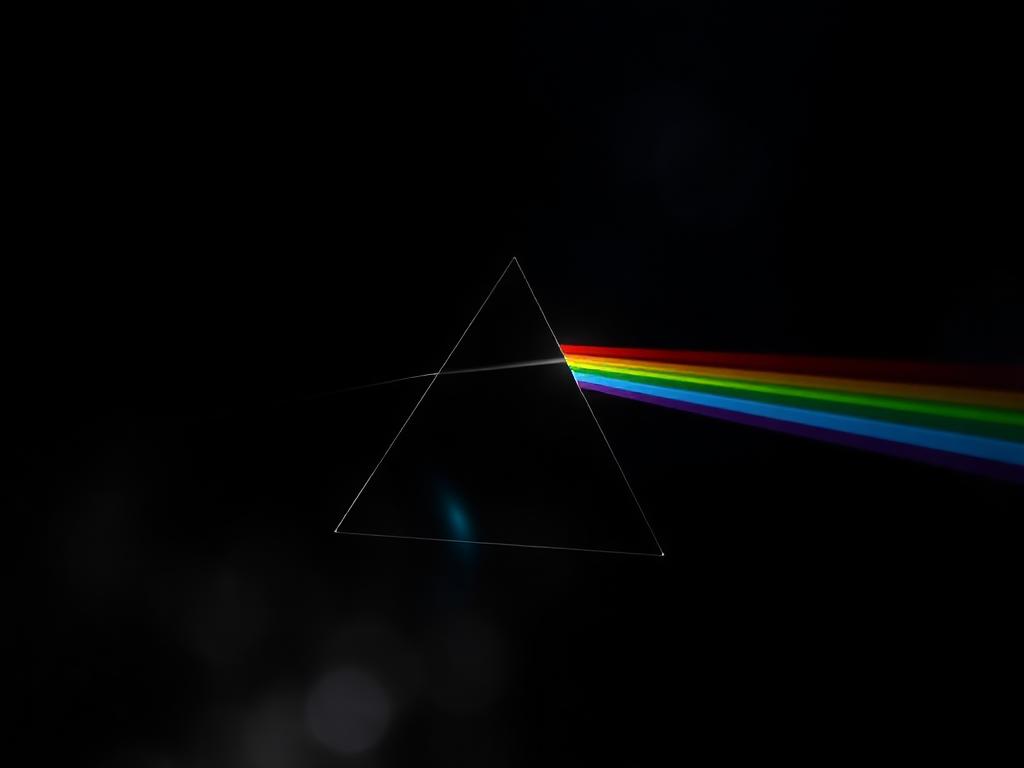
The miracle Syd Barrett could not reach is the same miracle available to anyone still in the middle of the long, bewildering, overwhelmingly human process of trying to find their way from the noise of the mind to the quiet truth of the heart. It is never too late. The channel is never irrevocably closed. The light that burned too bright was still light — and light, even refracted, even scattered across a prism into a dozen broken colors, is still illumination.
It is still something to see by.
Don't Give Up Before the Miracle
The Channel Is Never Closed"Remember when you were young, you shone like the sun." — Pink Floyd